An employee asks for an experience letter. Their joining date is easy to find, but they changed roles halfway through, and their resignation date differs from their last working day. Those two details can turn a five-minute task into a round of corrections. A good experience letter format in Word gives HR a starting point and makes it clear which details need checking before the letter goes out.
This guide covers what to include, how to adapt the wording for full-time, part-time and fixed-term employees, and how to prepare a PDF for issue. It also includes a filled-in sample and an employee request letter.
What is an experience letter?
An experience letter is a document an employer issues to confirm someone’s work history. It typically records where the employee worked, the position they held and the period they worked there. It can also describe their main responsibilities, which helps a reader understand what the employee actually did.
A relieving letter usually confirms the date an employee was formally released from their duties. An experience letter focuses on their role and tenure. If a former employee asks for both, check which details your company includes in each document before preparing them.
Which format of experience letter should HR use?
Most letters can fit on one page. Start with the company letterhead and issue date, then confirm the employment details in the first paragraph. Use the next paragraph for responsibilities and close with the authorised signatory’s details.
| Field | What HR should enter |
|---|---|
| Company name and letterhead | Use the employing entity’s name as recorded in the employee’s file. |
| Issue date | Enter the date the letter is issued. |
| Employee name | Match the spelling in HR records. |
| Designation and department | Use the recorded job title and department. Add earlier roles when the distinction matters. |
| Employment dates | Confirm the joining date and last working day. Write dates as “14 June 2024” to avoid ambiguity. |
| Employment type | Specify full-time, part-time or fixed-term employment where relevant. |
| Responsibilities | Include two or three duties HR or the reporting manager can verify. |
| Signature and contact | Add the authorised signatory’s name, designation and official verification contact if available. |
Skip salary, personal identifiers and reasons for leaving unless the employee has specifically requested them and company policy allows their inclusion.
Work experience letter format for full-time employees
A full-time letter can usually confirm the employee’s latest designation and total tenure. If the employee held several roles, state when each one began. For instance, “Priya joined as an Accounts Associate on 4 April 2022 and was promoted to Senior Accounts Associate on 1 July 2024.” This small addition prevents a reader from assuming Priya held the senior role throughout.
Here’s a filled-in example using fictional details.
Northfield Business Services Pvt. Ltd.
12 November 2026
To Whom It May Concern
This is to certify that Aditi Mehra worked at Northfield Business Services Pvt. Ltd. as a full-time Operations Executive from 3 July 2023 to 30 October 2026.
During her employment, Aditi coordinated daily order processing, investigated dispatch delays with the warehouse team and prepared weekly reports on pending orders.
We thank Aditi for her contribution and wish her well.
For Northfield Business Services Pvt. Ltd.
[Signature]
Rohan Kapoor
HR Manager
The responsibilities in this example tell the reader something a generic phrase like “handled operations” would leave open. Use the same level of detail for other roles. A sales coordinator might maintain distributor records and compile monthly order reports. A payroll associate might reconcile attendance data and prepare monthly payroll inputs.
Experience letter format for part-time employees
Use the same opening and signature block, and identify the role as part-time. Include weekly hours when the employee needs them and HR can verify them. If hours varied, include a verified average and the period it covers, or simply omit the hours.
This is to certify that [Employee Name] worked at [Company Name] as a part-time [Job Title] from [Start Date] to [Last Working Day]. During this period, [Employee Name] was responsible for [Responsibility 1] and [Responsibility 2].
Experience letter format for fixed-term employees
A fixed-term letter should reflect the dates the employee actually worked. If the company extended the contract, confirm the final date against the extension and HR records. Where someone worked through a staffing agency, check which organisation employed them before selecting the letterhead and signing the letter.
This is to certify that [Employee Name] was employed by [Company Name] as a fixed-term [Job Title] from [Start Date] to [Last Working Day]. During this period, [Employee Name] supported [Project or Team] and was responsible for [Responsibility 1] and [Responsibility 2].
Editable Word templates and PDF copies
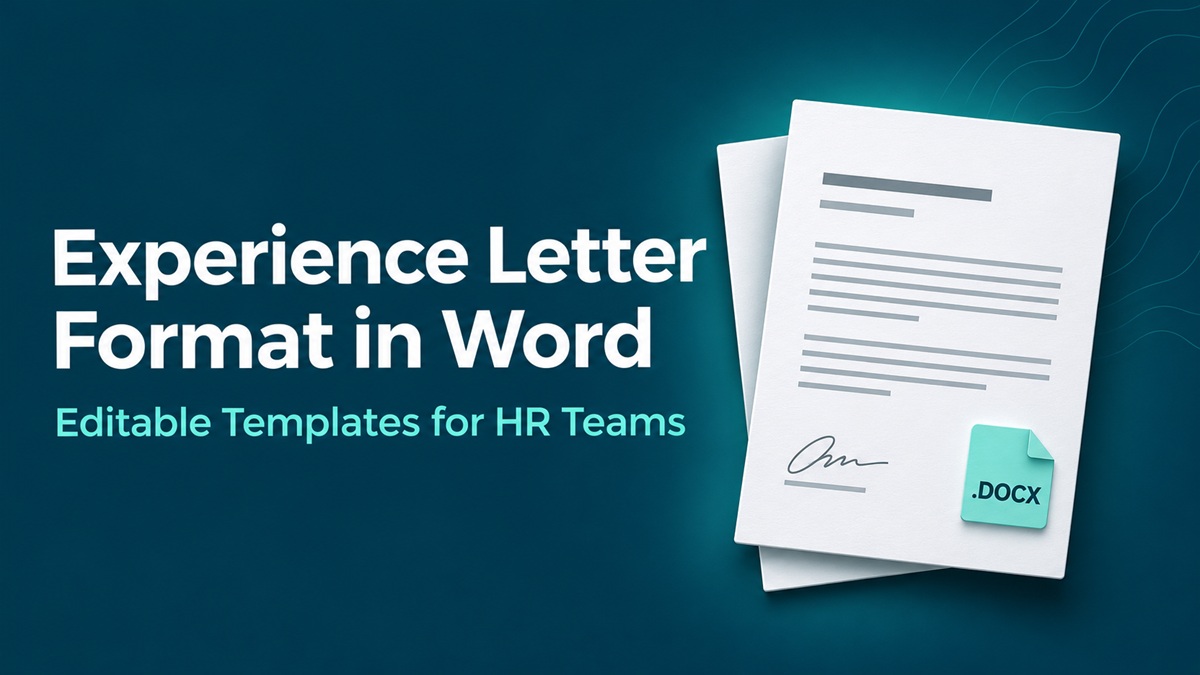
The editable download contains three employer templates and one employee request letter. Copy the page you need into a new document, replace the bracketed fields and add your company letterhead. For a repeat request, start from a clean master copy so a previous employee’s name or dates don’t carry over.
If you came here searching for an experience letter format PDF, you can use the same template. Once the letter is approved, export it to PDF and apply your company’s approved signature process. Open the final file before sending it to check that the letterhead and signature display correctly and that comments, placeholder text and tracked changes are gone.
How to request an experience letter from HR
If you searched for a work experience request letter format Word template, use the employee request page in the download. You can also paste the wording below directly into an email. Include your employee ID, designation and dates so HR can locate your record.
Subject: Request for an Experience Letter
Dear [HR Contact Name],
I’m writing to request an experience letter for my time at [Company Name]. I worked as [Job Title] in [Department] from [Start Date] to [Last Working Day]. My employee ID was [Employee ID].
Please include my designation and employment dates. If company policy allows, I’d also appreciate a brief description of my responsibilities.
Please send the signed letter to [Email Address]. Let me know if you need any additional details.
Thank you,
[Full Name]
Frequently Asked Questions
- Can HR reuse the work experience letter format?
Yes. Save the work experience letter format Word template as a master copy. Keep the layout consistent and adjust the employment type, dates, designation and responsibilities for each person. For employees who changed roles, add a short sentence with the relevant dates.
- What if the employee is still working with the company?
If your company issues letters to current employees, use present-tense wording such as “[Employee Name] has been employed with us since [Start Date] and currently works as [Job Title].” Include the issue date so the reader knows when HR confirmed the information.
- Does an experience letter need to include performance feedback?
A factual letter can confirm the employee’s role, dates and responsibilities. If company policy allows performance comments, keep them specific and have the appropriate manager verify them.
- What should HR check before issuing the letter?
Read it once from the recipient’s point of view. Can they tell who employed the person, what work they did, when they worked there and whom to contact for verification? Then compare the name, designation and dates against HR records before the authorised signatory approves it.