

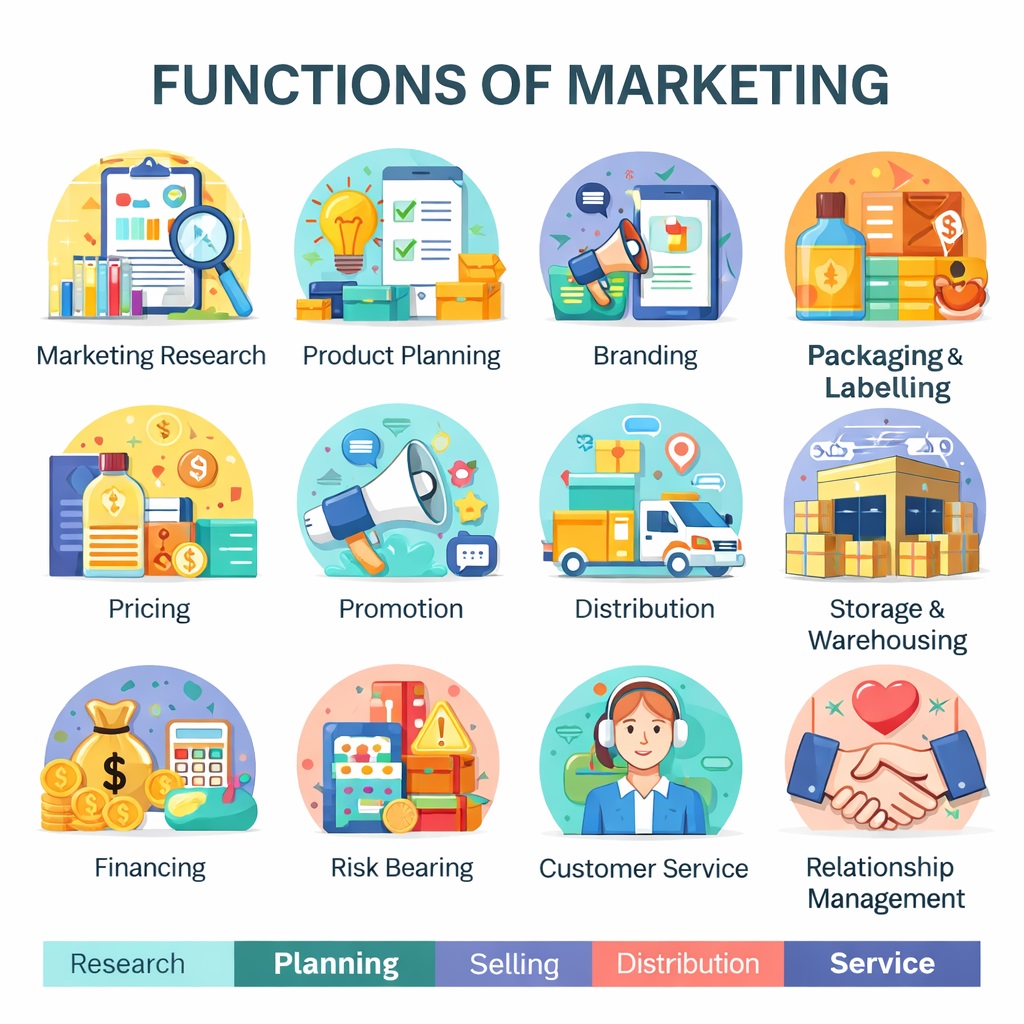
If you’ve ever wondered what are the functions of marketing beyond “posting ads” or “selling products,” here’s the thing: marketing is a complete system that starts long before a product is sold and continues long after the purchase. It includes research, product decisions, pricing, promotion, distribution, customer support, and relationship-building.
This blog will explain the functions of marketing in detail with clear, real-life examples. It’s also written in a way that works well for functions of marketing class 12 and functions of marketing management class 12, while still being practical for business owners and professionals.
What Are the Functions of Marketing?
What are the functions of marketing?
They are the activities a business performs to identify customer needs, create value, deliver products/services efficiently, and build long-term demand and trust.
In simple terms, marketing functions help a company answer four questions:
- Who should we serve?
- What should we offer?
- What should it cost?
- How will it reach customers, and why will they choose us?
When teachers say “explain the functions of marketing,” they’re asking you to describe the set of activities that make exchange possible and profitable.
Functions of Marketing Management
Before we go into the list, it helps to understand functions of marketing management. Marketing management is the planning, organizing, directing, and controlling of marketing activities to meet business goals.
Typical functions of marketing management include:
- Market planning and goal-setting
- Designing marketing strategy (targeting, positioning)
- Organizing teams, budgets, tools, and campaigns
- Measuring results (sales, leads, market share, retention)
- Improving and optimizing decisions continuously
A real-life example:
A skincare brand notices that sales spike in winter. Marketing management plans winter campaigns in advance, allocates budget to moisturizers, optimizes website landing pages, and tracks conversions weekly to refine messaging.
12 Functions of Marketing (Detailed + Examples)
Many textbooks mention 12 functions of marketing. The categories may vary slightly by book, but the core ideas are stable. Below is a practical and exam-friendly version that can be used in functions of marketing in principles of marketing topics too.
1) Marketing Research and Information Management
This is the starting point. Businesses study customers, competitors, trends, and demand.
Real-life example:
A food delivery app runs surveys and finds customers want late-night healthy options. It adds a “Healthy After 10 PM” category and partners with salad and bowl outlets.
This is one of the most important points when you explain the functions of marketing in detail because every decision (price, product, promotion) depends on good information.
2) Product Planning and Development
Marketing helps decide what product to create, improve, or discontinue.
Real-life example:
A smartphone brand learns users care more about battery life than extra camera lenses in mid-range phones. Next model: bigger battery, fewer expensive camera upgrades.
3) Standardization and Grading
Standardization ensures consistent quality. Grading classifies products by quality levels.
Real-life example:
Basmati rice is sold in grades (super, premium, regular). Customers pay based on grade and trust that the quality matches the label.
This is common in agriculture, textiles, tea, coffee, and even packaged foods.
4) Branding
Branding creates identity and trust. It helps customers recognize and choose quickly.
Real-life example:
Two bottled water brands may have similar quality, but the one with stronger branding gets repeat buyers because customers feel it’s safer or “more premium.”
Branding is not just a logo. It’s perceived value.
5) Packaging and Labelling
Here’s where functions of packaging in marketing becomes super important. Packaging protects, informs, and sells.
Real-life example:
A kids’ cereal brand uses bright colors, mascots, and easy-to-read nutrition labels. Parents notice the “high fiber” label and choose it over competitors.
Packaging functions include:
- Protection during transport
- Convenience (resealable packs)
- Brand visibility on shelves
- Legal info (MRP, expiry, ingredients)
- Product differentiation
6) Pricing
Marketing influences pricing based on demand, competition, customer ability to pay, and brand positioning.
Real-life example:
A café charges ₹80 for regular coffee and ₹170 for “single-origin pour-over.” The second isn’t just about cost; it’s about positioning for a premium audience.
Pricing decisions directly shape profit and market share.
7) Promotion (Advertising, Sales Promotion, Personal Selling, PR)
Promotion communicates value and persuades customers.
Real-life example:
A new gym offers:
- Instagram ads (advertising)
- “Join with a friend and get 20% off” (sales promotion)
- Trainer calling leads and giving a tour (personal selling)
- Local newspaper feature about fitness drive (PR)
Promotion is what most people think marketing is, but it’s only one function.
8) Distribution and Transportation
Products must reach the right place at the right time.
Real-life example:
An ice cream brand needs cold-chain transportation. If distribution fails, the product melts and brand trust collapses.
Transportation is a major function in FMCG, pharma, dairy, and e-commerce.
9) Storage and Warehousing
This maintains supply and prevents shortages.
Real-life example:
A clothing brand stores winter jackets months in advance so it can deliver quickly when demand spikes in November.
Warehousing supports faster delivery, stable pricing, and consistent availability.
10) Financing
Marketing activities cost money: ads, distribution, inventory, retail displays, etc.
Real-life example:
A phone retailer buys inventory using short-term credit. This financing allows the retailer to stock new models immediately.
Without finance, sales opportunities get missed.
11) Risk Bearing
Marketing involves risk: unsold inventory, changing trends, damaged goods, returns.
Real-life example:
A toy company produces a large batch for a festival season. If a new trend emerges, old inventory may remain unsold and must be discounted.
Managing risk is part of smart marketing.
12) Customer Service and Relationship Management
Marketing doesn’t end after the sale. Support, loyalty, and retention are key.
Real-life example:
A D2C brand offers easy returns and quick WhatsApp support. Customers trust the brand, reorder, and recommend it.
In modern business, retention is often cheaper than acquisition.
10 Functions of Marketing (Short Version)
Many students also search 10 functions of marketing because some syllabi reduce the list. If you need a quick set of ten, combine a few overlapping areas:
- Marketing research
- Product planning
- Branding
- Packaging and labelling
- Pricing
- Promotion
- Distribution
- Transportation
- Warehousing
- Customer service
This list is useful if someone asks you to explain functions of marketing briefly.
Functions of Marketing Channels
Now let’s talk about functions of marketing channels, meaning wholesalers, distributors, retailers, and online platforms that help move products from producer to consumer.
Key functions of marketing channels:
- Collecting information about local demand
- Breaking bulk (selling in smaller quantities)
- Providing product variety in one place
- Offering credit to retailers/customers
- Physical distribution and local delivery
- Promotion at store level (displays, shelf placement)
- After-sales support (in some categories)
Real-life example:
A shampoo company sells to distributors, who supply thousands of kirana stores. The store acts as the final channel where customers actually pick the product.
Functions of Retail Marketing
Retail marketing focuses on how stores attract customers and drive purchase decisions. The functions of retail marketing include:
- Store location planning (footfall matters)
- Visual merchandising (shelves, lighting, signage)
- Product assortment (right mix of brands and sizes)
- Pricing and offers (combo deals, discounts)
- In-store promotion (sampling, demo counters)
- Customer experience (billing speed, staff behavior)
- Loyalty programs (points, cashback)
Real-life example:
A supermarket places snacks and chocolates near the billing counter. That’s retail marketing driving impulse purchases.
Functions of Marketing Manager
A lot of people also search functions of marketing manager because it’s practical and career-focused. A marketing manager typically:
- Studies market demand and customer insights
- Defines target audience and positioning
- Plans campaigns across platforms
- Coordinates with sales, product, and distribution teams
- Manages budgets and marketing calendars
- Tracks performance (leads, CAC, ROAS, conversions)
- Improves messaging based on data
- Builds brand reputation and customer trust
Real-life example:
A marketing manager in an e-commerce brand checks why cart abandonment is high, works with the tech team to improve checkout speed, and runs retargeting ads to recover sales.
Explain Any Four Functions of Marketing (Exam-Ready Answer)
If your question is: explain any four functions of marketing, you can use this clean structure:
- Marketing Research: Collects customer and market data to guide decisions.Example: Survey shows customers want sugar-free drinks, so brand launches a new variant.
- Branding: Builds identity and trust.Example: A strong brand helps customers choose quickly without comparing too much.
- Pricing: Decides the product’s value in money terms.Example: Premium pricing makes a perfume feel exclusive.
- Promotion: Communicates product benefits and persuades customers.Example: Influencer demo increases awareness and drives sales.
Use these four and you’ll be safe in most exams.
Explain Any Eight Functions of Marketing (Exam-Ready Answer)
For explain any eight functions of marketing, choose these because they’re easy to explain with examples:
- Marketing research
- Product planning
- Branding
- Packaging and labelling
- Pricing
- Promotion
- Distribution
- Customer service
That covers the full marketing journey end-to-end.
Explain the Various Functions of Marketing
When someone says explain the various functions of marketing, they usually mean “cover all the key areas from start to finish.” A good way to remember it is:
- Before production: Research, planning
- During production: Standardization, branding, packaging decisions
- Before selling: Pricing, promotion, distribution setup
- After selling: Service, relationships, feedback
That is the whole marketing cycle in action.
Functions of Marketing PDF (What People Usually Mean)
Many people search functions of marketing pdf because they want a downloadable, notes-style format. I can’t attach a PDF directly here unless you ask for a “PDF file,” but here’s a PDF-style quick notes section you can copy into your document:
Functions of Marketing (Notes):
- Research and information collection
- Product planning and development
- Standardization and grading
- Branding
- Packaging and labelling
- Pricing
- Promotion
- Distribution
- Transportation
- Warehousing
- Financing
- Risk bearing
- Customer service and CRM
If you want, tell me and I’ll convert this blog into a clean “notes + headings” version you can paste into a PDF template.
Why These Functions Matter in Real Business
What this really means is: marketing isn’t one department doing posters. It’s a system that keeps a business alive.
- Without research, you sell the wrong product.
- Without pricing strategy, you lose profit or customers.
- Without channels, you have demand but no delivery.
- Without service, you lose repeat buyers.
That’s why companies that “do marketing properly” don’t rely on luck. They create demand, deliver value, and build trust.
Final Wrap
So, what are the functions of marketing? They are the set of activities that connect a product to the market successfully: from research and planning to branding, pricing, promotion, distribution, and customer relationships.

.jpg)