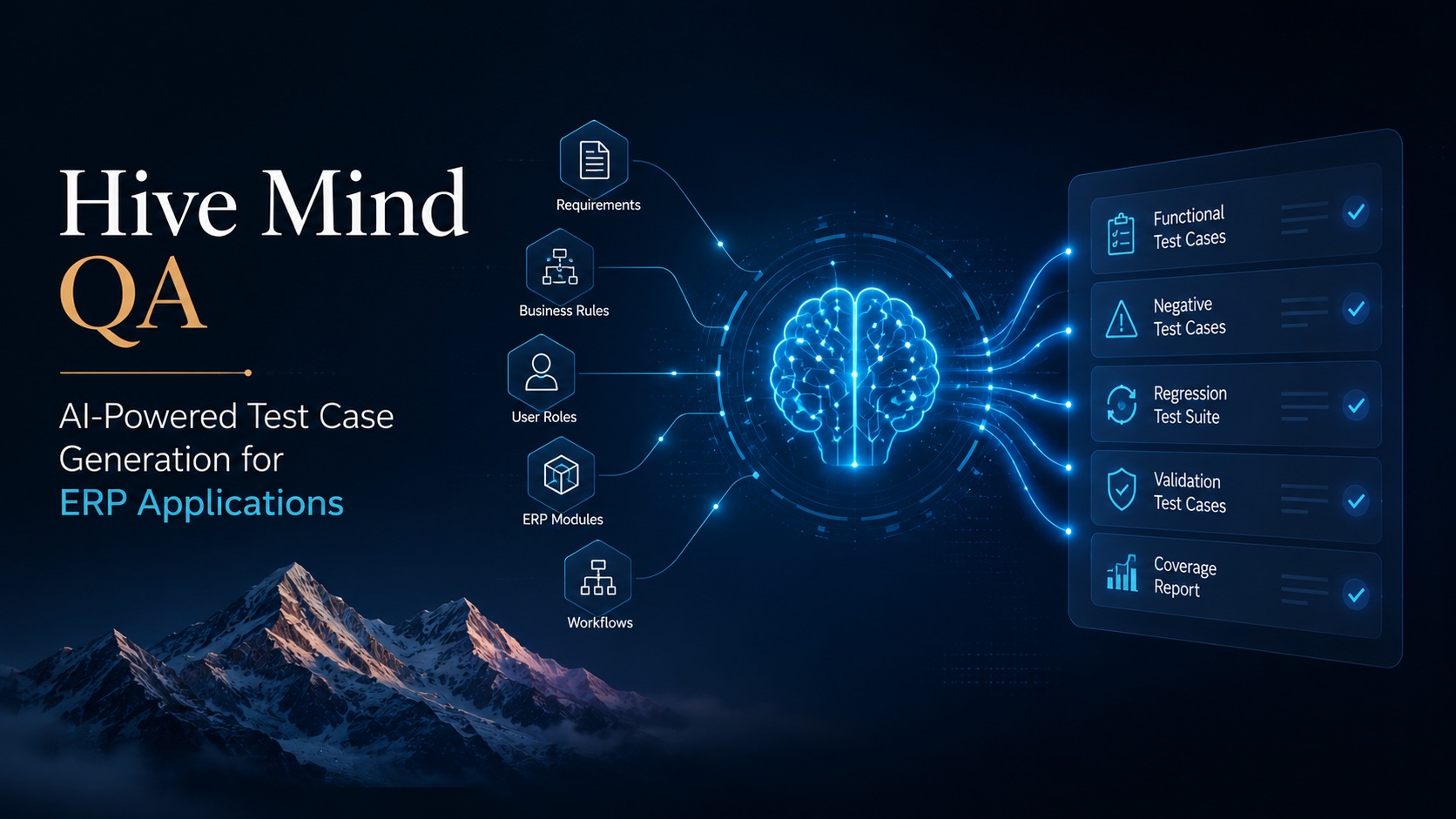
Testing ERP systems is slow, complex, and heavily dependent on manual effort. In this demo, the team showcased Hive Mind QA, an AI-powered test case generator designed to reduce that burden by automatically understanding an ERP application and producing structured test cases.
What is Hive Mind QA?
Hive Mind QA is built around the idea of hive mind intelligence and a neural forest. The concept is simple: instead of relying on a single layer of analysis, the platform uses multiple intelligence layers to study an ERP system and generate meaningful test cases from it.
The goal is to help QA teams move faster while improving coverage and consistency.
How the Platform Works
The workflow starts with a simple setup:
- Enter the program name
- Connect the repository
- Select the branch to scan
Once the repository is scanned, the platform analyzes multiple parts of the application, including:
- Controllers
- Models
- APIs
- Database queries
- UI screens
- Business logic
This allows the system to build a deeper understanding of how the ERP works before generating test cases.
Automated Test Case Generation
After analysis, Hive Mind QA automatically generates test cases across a wide range of categories, including:
- Functional testing
- Boundary testing
- Negative testing
- API testing
- Database testing
- Security testing
- Audit and compliance testing
In the demo, the platform generated 150 test cases within minutes. These test cases covered important areas such as:
- Mandatory fields
- Business rules
- APIs
- Business flows
- Workflows
Each generated test case included:
- Preconditions
- Test steps
- Expected results
- Applied validations
This structure makes the output immediately useful for QA teams looking for speed without losing clarity.
Export and Review
The generated test cases can also be exported as a CSV file, making it easier for teams to review, share, and integrate them into existing QA workflows.
Beyond export, the platform also supports in-platform review through its workspace and test studio views.
Inside the Hive Mind Workspace
One of the standout aspects of the demo was the Hive Mind Workspace, presented as a visual “neural forest.” This interface represents intelligent nodes working together to analyze the application.
The workspace highlights:
- Source code intelligence discovered from the application
- Validation discovery
- Repository code analysis
- API and database discovery
- Security and compliance checks
- Agent activity related to test generation
The Test Studio then displays all generated test cases, allowing users to click into each one for more detail.
Why This Matters
ERP testing is challenging because business logic is often deeply interconnected across workflows, validations, APIs, and backend systems. Hive Mind QA addresses this by using code-level and application-level understanding to generate broad, structured test coverage automatically.
That means:
- Less manual effort for testers
- Faster QA cycles
- More consistent test documentation
- Better coverage of business-critical scenarios
What’s Next?
An interesting future direction discussed in the demo was agentic test case execution — moving beyond generating test cases to actually running them autonomously. If developed further, this could make the platform even more powerful by connecting intelligent test design with automated execution.
Final Thoughts
Hive Mind QA presents a promising approach to modern QA automation for ERP applications. With its multi-layered intelligence model, fast test generation, and visually engaging workspace, it offers a strong foundation for teams looking to improve both testing speed and quality.
If the product continues evolving toward autonomous execution and iterative improvement, it could become a valuable addition to next-generation ERP QA workflows.